International backing does not imply that all aspects are finalized, but it does confirm that the overall process is aligned with global standards and opens the door to real competition between major players in the dredging market.
“The terms largely satisfy the recommendations and best practices of this body,” the document states.
The document, running over a hundred pages and obtained exclusively by Agencia Noticias Argentinas, reviews technical requirements, the economic model, control mechanisms, safety standards, and the actual capacity of the global market to compete in the process.
Guaranteed International Competition
The report dedicates a specific section to the availability of a fleet and companies capable of meeting the dredging requirements, which is the central component of the contract.
For the national administration, this endorsement constitutes a strategic backing in one of the most relevant tenders in recent years.
Buenos Aires, Dec 5 (NA) – The United Nations Conference on Trade and Development (UNCTAD) has backed in a technical report the tender launched by the Government of Javier Milei for the concession of the Trunk Waterway (VNT), better known as the Paraná-Paraguay Waterway.
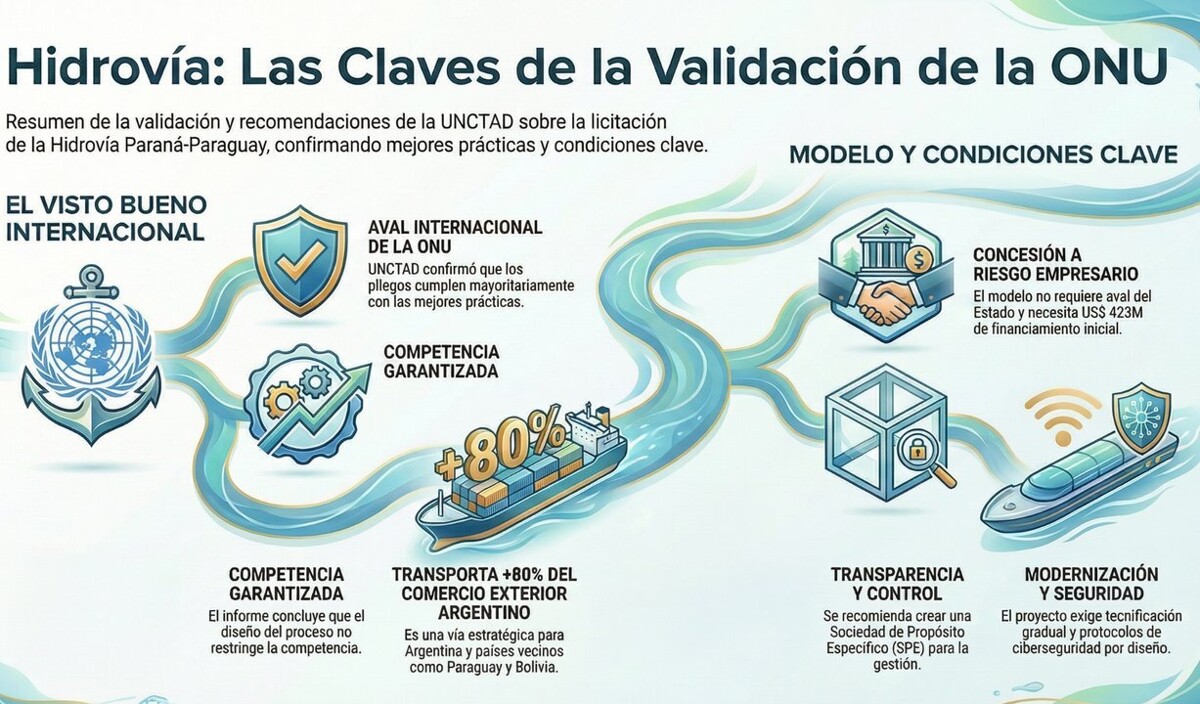
According to the international body, the new terms “largely meet” the labor, technical, and economic recommendations and best practices suggested by the entity itself, and guarantee adequate conditions for international competition.
The endorsement arises from the final analysis sent this week to the Argentine team, within the framework of the Memorandum of Understanding signed with the National Agency of Ports and Navigation (ANPyN).
Among the recommendations are to formalize a procedure for modifying conditions due to “unforeseen acts of public interest,” strengthen the professional requirements for the technical representative of each bidder, and order certain articles related to economic evaluation.
Regarding the award process, the body observes that the tender should be awarded to the bidder who “obtains the highest score” by combining technical and economic evaluation, maintaining a minimum quality threshold for the former.
It also proposes to clarify that the trust foreseen in Annex 10 must be concluded once the remunerations are exhausted and not necessarily with the end of the concession term.
A Strategic Asset for Regional Trade
The report highlights the critical role of the Waterway for the Argentine and South American economy: over 80% of the country's foreign trade uses the Trunk Waterway, which is also essential for Paraguay, Bolivia, Uruguay, and part of southern Brazil.
In this sense, it states that the concession designed “at entrepreneurial risk and without state backing” is suitable, as long as it is accompanied by a robust state supervision system led by the ANPyN.
In the initial stages, it indicates, the concession will require a strong injection of capital—estimated at over 420 million dollars between contributions and financing—due to initial investments in dredging, signaling, and modernization of the Waterway.
IP
A Political and Technical Message in a Sensitive Debate
Within the framework of a tender process historically fraught with political tensions and business expectations, UNCTAD's approval becomes a key input for the Government.
Among the recommendations is the creation of a Special Purpose Vehicle (SPV) to isolate assets, improve transparency, and facilitate contract control.
UNCTAD also calls for reinforcing the technological upgrading of the system, with staggered investments, a cybersecurity scheme “designed from the start,” and permanent technical commissions to monitor dredging, buoyage, salvage, technology, and accounting of the concession.
Economic Impact and Financial Model
The body backs the proposed economic model, though it suggests reviewing every ten years the hypotheses of income, investments, and tariffs to ensure the contract's sustainability.
It establishes that four world-leading companies—Jan de Nul, DEME, Boskalis, and Van Oord—have a sufficient fleet to meet the tender's requirements.
Furthermore, UNCTAD identifies other firms such as Inai Kiara, Rhode Nielsen, Great Lakes and Dock Co. and Weeks Marine, which, while they may not individually meet the minimum requirements, “could jointly present themselves with others to reach the required fleet size.”
“The reality of the sector allows us to ensure that not only is there no restriction on competition within the framework of the contest, but it would also be possible to complete the bids with aspects that would improve the service guarantees of the new concessionaire,” the body concludes in its final recommendations.
Technical Endorsement, with Specific Adjustments
UNCTAD states that the terms largely meet the best practices suggested by the body, although it recommends introducing clarifications in the operational aspects of the contract.